Start with the task the system should solve
A DAM manages images, videos, audio files, presentations, layout files, and other media that are reused continuously and distributed to teams, partners, and channels. For contracts, invoices, or personnel files, a document management system (DMS) is the better choice.
Before comparing vendors, define who will use the system, which media types it will manage, and who needs external access. A mid-sized company with one marketing team has different requirements than an organization with many locations, agencies, and partners.
The most important selection criteria
Hosting and data protection
Clarify where data is stored, who acts as processor, and which subprocessors are involved. For many companies in Austria, Germany, and Switzerland, hosting in the EU with a clear data processing agreement is a requirement. Also ask about backups, retention periods, and how AI features handle your data.
Operating model
With multi-tenant, one platform serves several customers with strictly separated data. With single-tenant, you get your own instance with test and production systems and individual customization. Which model fits depends on your requirements for security, integration, and customization.
Search and AI
What matters is how quickly users find the right asset. Check metadata search, filters, full-text search, and AI-powered features such as automatic tagging and natural-language search. Test with your own data, not demo material.
Permissions and sharing
Check roles and rights down to folder, asset, or portal level, plus secure sharing and uploads for external partners, agencies, and photographers. Portals for retailers or press require fine-grained access rules.
Interfaces and API
A DAM is rarely an island. Check documented APIs, the authentication method, ready-made connections to PIM, CMS, shop, Adobe, and Microsoft, and delivery of media through a CDN. API-first means functions are built as an interface first and the user interface uses them.
Onboarding and migration
Ask how existing data is migrated, how your metadata is mapped, and how long a realistic start takes.
Licensing model
Watch for user limits, storage and transfer costs, costs for AI features, and add-on modules. A model without a user limit makes it easier to include teams and partners.
Support and collaboration
Language, time zone, support availability, and contacts in the DACH region often matter more in daily use than the feature list.
Classifying vendors in the DACH region
The market is broad. For orientation, group vendors by focus, not by ranking.
Standalone DAM platforms
They cover media management, search, and distribution as their core product. This includes internationally established vendors such as Bynder as well as Agravity GlobalDAM from Linz, whose core market is the DACH region.
Brand management platforms
They focus on brand guidelines, templates, and approvals, for example Frontify from Switzerland.
PIM systems with media management
They manage product data and include their own media function, for example Atamya from Germany, Elytra from Switzerland, or Pimcore from Austria. If media is used beyond products, a standalone DAM complements the PIM. Read more in DAM vs. PIM.
Specialized systems for video and broadcast
Frame-accurate production and editing integration call for dedicated systems. MAM system or DAM explains the difference.
The names mentioned are examples, not a rating. Always verify scope, hosting, and terms directly with the vendor.
Questions to ask vendors
- Where is data stored, and who is the processor?
- Does the system run as multi-tenant or single-tenant, and how is my data separated?
- How do search and AI features work with my media and metadata?
- How finely can rights be controlled for internal and external users?
- Which APIs exist, how does authentication work, and what is included in my package?
- How is existing data migrated, and how long does a realistic start take?
- How does the licensing model work, and are there hidden costs or scaling factors?
- Which references exist in my industry and region?
How to test a DAM with real data
Pick three to five typical tasks from your daily work, for example finding a product image, approving a campaign for an agency, or providing a video in several formats. Test them with your own media and with the people who will use the system every day.
A pilot with real data shows faster than any presentation whether structure, search, and permissions fit you.
Where Agravity GlobalDAM fits
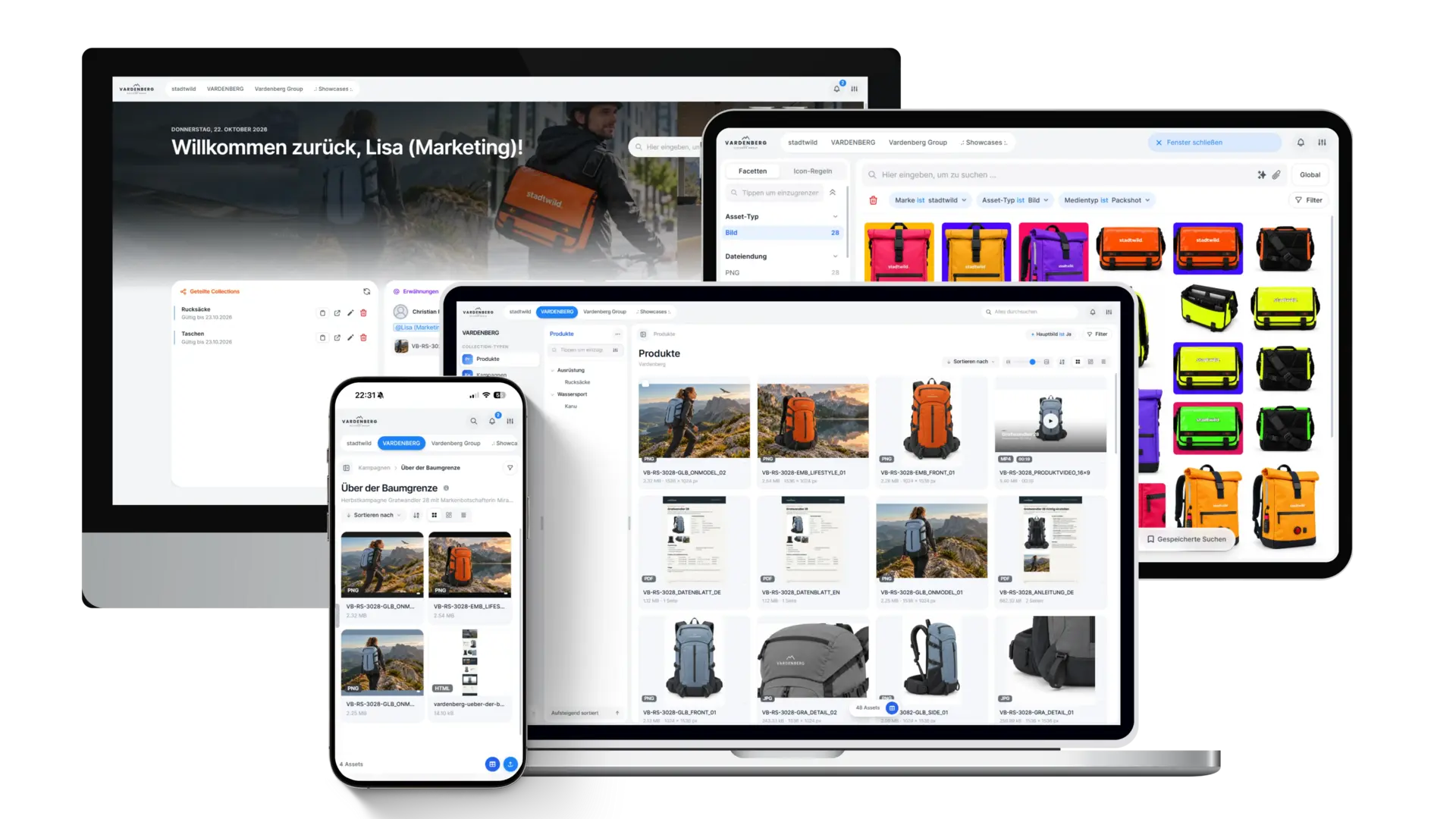
Agravity GlobalDAM comes from Linz, Austria, and runs cloud-native on Microsoft Azure in the EU. The core market of Agravity is the DACH region: contacts, consulting, and support work in your language and time zone. The system is API-first: the Public API works with an API key, the Private API exclusively with OAuth 2.0. Both are included in all packages. The number of users is not limited.
Depending on the package, it also offers AI-powered search, roles and approvals, portals, and secure sharing and upload for external partners. Packages are available as multi-tenant and as single-tenant with your own instance. Agravity GlobalDAM is listed on the Azure Marketplace. For a practical example, read the LEICHT Küchen AG success story.
Frequently asked questions
What does a DAM system cost?
Costs depend on the number of users, storage, operating model, and add-on features. Compare offers based on the same assumptions. For Agravity GlobalDAM, we discuss the right package based on your requirements.
How long does it take to introduce a DAM?
As an industry standard, 3 to 9 months until the first go-live apply, about 6 months on average. The exact timeline depends on data volume, structure, and integrations. A pilot with clearly defined media can usually start faster than a full project.
Do I need a DAM, or is a file server enough?
A file server stores files. A DAM makes them usable through metadata, search, rights, and distribution. Once media is searched for often, approved, or shared with external parties, a DAM pays off.